
Board of Port Commissioners Approves Trust Lands Use Plan
Contact: Brianne Mundy Page, 619.348.1518, bpage@portofsandiego.org
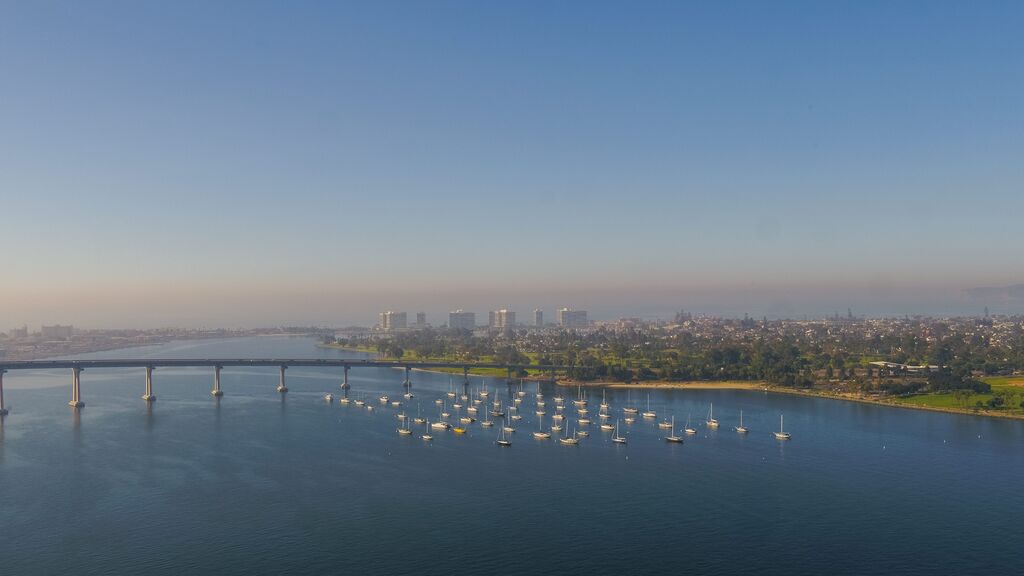
The Port of San Diego Board of Port Commissioners has approved the Trust Lands Use Plan, also known as the TLUP. The Port developed the TLUP as required by Senate Bill 507 (Atkins), legislation adopted in 2019 by which the California State Lands Commission (State Lands) granted the Port approximately 8,000 additional acres of tidelands and submerged lands within San Diego Bay. Consistent with the Port’s mission, the Port Act, and the Coastal Act, the plan provides goals, policies, and information on allowable uses and activities within the newly acquired areas and will be added to the Port Master Plan via a Port Master Plan Amendment (PMPA), bringing the newly granted areas into the Port’s coastal permitting jurisdiction.
The TLUP’s goal is to preserve, protect, and maintain existing uses and activities – like water recreation, cargo and other large vessel movement via the federal navigation channel, commercial fishing, public safety, national security, environmental conservation, and more – while also allowing expansion, improvement, or enhancement of some uses. As part of the Port’s commitment to transparency and community engagement, the Port collected input from the public and stakeholders.
"Approval of the Trust Lands Use Plan marks an important milestone in our ongoing commitment to be responsible stewards of San Diego Bay," said Chair Danielle Moore, Port of San Diego Board of Port Commissioners. "This plan balances environmental conservation with economic opportunity and public access, ensuring that these newly granted lands will benefit our communities and the people of California today and for generations to come."
In addition to approving the TLUP, the Board also adopted its associated Mitigated Negative Declaration (MND) pursuant to the California Environmental Quality Act (CEQA) and directed staff to file the TLUP PMPA with the California Coastal Commission for certification. Once the PMPA is certified by the Coastal Commission, Port staff will submit the TLUP to State Lands for approval, as stipulated in SB 507. Port staff anticipates final approval of the TLUP in 2026.
The added tidelands area is often referred to as the “donut hole” because it is encircled by tidelands and submerged lands already under Port management. The newly granted areas begin from the mouth of San Diego Bay down to and including the San Diego Bay National Wildlife Refuge. (Note: The area granted to the Port comprises tidelands and submerged lands only, not the water column. The granted area also does not include submerged lands managed by the U.S. Navy.) The TLUP only addresses the newly granted area and does not address the submerged lands and tidelands included in the Port’s jurisdiction prior to 2020. No landside development is contemplated in the TLUP, apart from minimal recreational uses and environmental or habitat conservation uses.
Since 1962, the Port has successfully managed and balanced a mix of coastal-dependent uses on and around San Diego Bay for the people of California while striking a balance that respects both local perspectives and broader statewide public interests. The Port does this in a manner that promotes commerce, navigation, recreation, fisheries, and environmental stewardship consistent with the Port Act, the Coastal Act, and the Public Trust Doctrine. Based on this history and expertise, State Lands recognized the Port as being in the best position to manage and ensure efficient oversight of the additional area.
The Port provides economic vitality, environmental protection, and community benefit through a balanced approach to the maritime industry, tourism, water and land recreation, ecological preservation and restoration, and public safety.
ABOUT THE PORT OF SAN DIEGO
The Port of San Diego serves the people of California as a specially created district, balancing multiple uses on 34 miles along San Diego Bay spanning five cities. Collecting no tax dollars, the Port manages a diverse portfolio to generate revenues that support vital public services and amenities.
The Port champions Maritime, Waterfront Development, Public Safety, Experiences and Environment, all focused on enriching the relationship people and businesses have with our dynamic waterfront. From cargo and cruise terminals to hotels and restaurants, from marinas to museums, from 23 public parks to countless events, the Port contributes to the region’s prosperity and remarkable way of life on a daily basis.